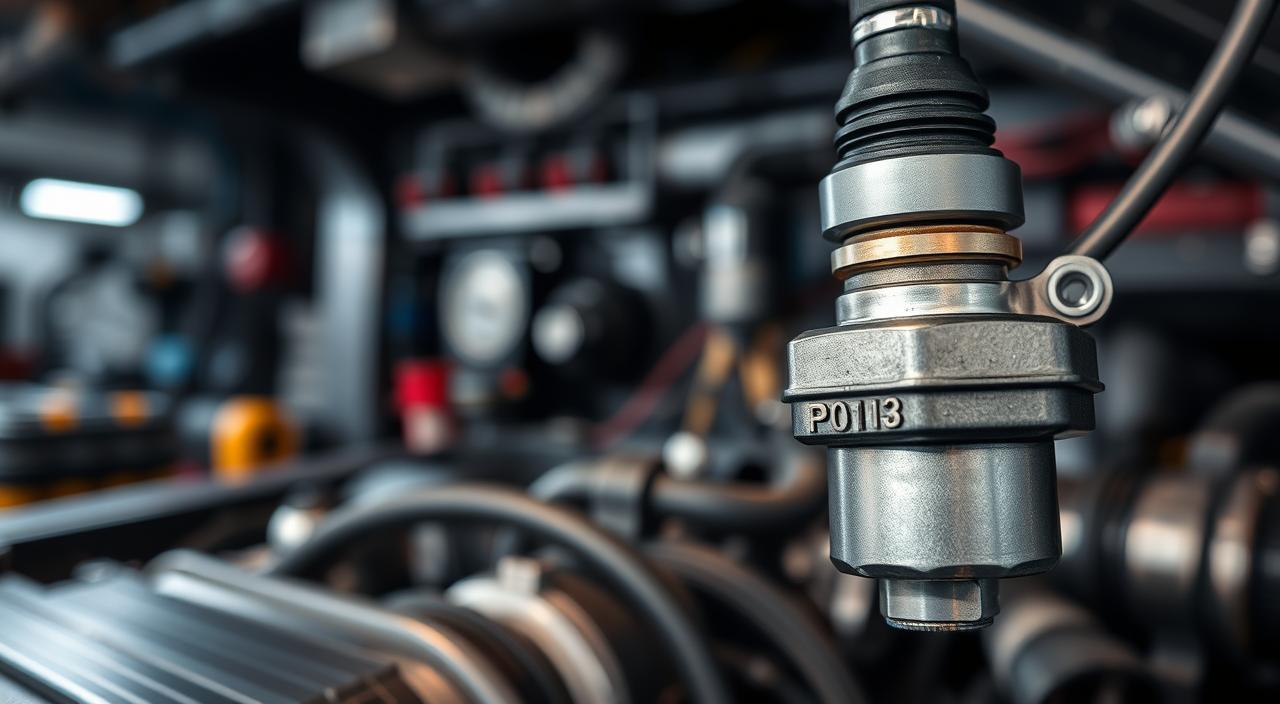
I got the P0113 code on my car. It’s about the intake air temperature sensor sending a high signal. This can mess with how the engine works. We need to fix it fast.
In this article, I’ll show you how to find and fix the p0113 intake air temperature sensor high input problem. We’ll look at what might cause it, what signs to watch for, and how to make your car run right again.
Knowing about the p0113 code and following our guide will help you solve the issue quickly.
What Does the P0113 Code Mean?
A P0113 code means the engine control unit (ECU) sees too high a voltage from the intake air temperature sensor. This code is about the intake air temperature sensor circuit. It shows there might be a problem that needs fixing.
Definition and Explanation of the Error Code
The P0113 code is a common OBD-II code for many cars. It means the intake air temperature sensor is sending a voltage that’s too high, over 4.9 volts. This sensor changes its resistance with temperature changes. It helps the ECU know the air temperature to mix fuel right.
How the ECU Interprets This Error
The ECU sees the P0113 code as a sign of a bad intake air temperature sensor or its circuit. When this code shows up, the ECU might use a fixed air temperature value. This can cause the engine to run poorly, use more fuel, and make more emissions. Knowing how the ECU sees this error is key for fixing it right.
| Voltage Reading | ECU Interpretation | Potential Cause |
|---|---|---|
| Above 4.9 volts | P0113 Code Triggered | Faulty IAT Sensor or Circuit Issue |
| Normal Range (0.1-4.9 volts) | Normal Operation | N/A |
| Below 0.1 volts | P0112 Code Triggered | Short Circuit or Faulty Sensor |
Understanding the Intake Air Temperature Sensor
The intake air temperature sensor is very important. It helps the engine control unit (ECU) make smart choices. It makes sure the engine works well in different temperatures.
Function and Purpose
This sensor checks the air temperature going into the engine. The ECU uses this info to figure out the best fuel mix and timing for the engine.
Location in Different Vehicle Makes
Where the intake air temperature sensor is can change. It’s usually in the intake manifold or air intake duct. For example, in some Toyotas, it’s in the intake manifold. In some Fords, it’s part of the mass airflow sensor.
How It Affects Engine Performance
This sensor really matters for how well the engine runs. If it’s not working right, you might see bad fuel use, rough idling, and less power. Here’s what can happen if it goes wrong:
| Condition | Effect on Engine Performance |
|---|---|
| Faulty Sensor | Poor fuel economy, rough idling, decreased engine power |
| Incorrect Temperature Reading | Incorrect fuel-to-air ratio, potentially causing engine knock or pre-ignition |
| Sensor Circuit Issue | Engine stumbling, hesitation, or stalling |
Common Causes of P0113 Intake Air Temperature Sensor High Input
The P0113 code can be caused by several issues. These need to be fixed to solve the problem.
Damaged or Corroded Wiring
One main cause is damaged or corroded wiring. Corrosion or damage to the wiring can mess up the signal to the ECU. This leads to wrong temperature readings.
Failed Sensor
A failed intake air temperature sensor is another common cause. The sensor might be faulty due to internal failure or contamination. This causes it to send a high voltage signal to the ECU, seen as a high temperature reading.
Circuit Issues
Circuit problems, like short circuits or open circuits, can also cause the P0113 code. These issues can happen in the wiring or connectors, affecting the signal.
ECU Problems
In some cases, the problem might be with the ECU. ECU malfunctions can make the sensor data wrong. This results in the P0113 error code.
To find the P0113 code’s cause, check these areas:
- Wiring condition and integrity
- Sensor functionality and condition
- Circuit continuity and resistance
- ECU operation and software status
By knowing and fixing these common causes, you can solve the P0113 intake air temperature sensor high input issue.
Symptoms You Might Experience
A bad intake air temperature sensor can cause many problems. It can lead to poor fuel economy and rough idling. This is because the sensor doesn’t work right, affecting the engine’s performance.
Poor Fuel Economy
One main symptom is a drop in fuel efficiency. This happens because the engine control unit (ECU) can’t get the intake air temperature right. So, it makes an air-fuel mixture that’s not good.
Hard Starting Conditions
A bad intake air temperature sensor also makes starting hard. The ECU needs the right temperature to know how much fuel to use at start-up. If it gets it wrong, the engine might not start right.
Rough Idle and Performance Issues
Another symptom is a rough idling engine. It might stumble or hesitate. This is because the faulty sensor makes the air-fuel mixture wrong.
Check Engine Light
The check engine light coming on is a big clue. It means there’s a problem, like the P0113 code. This code is about the intake air temperature sensor.
| Symptom | Description |
|---|---|
| Poor Fuel Economy | Decrease in fuel efficiency due to incorrect air-fuel mixture |
| Hard Starting | Difficulty starting the engine due to improper fuel injection |
| Rough Idle | Engine idles roughly or stalls due to incorrect air-fuel mixture |
| Check Engine Light | Illumination of the check engine light indicating a P0113 code |

Tools Needed for Diagnosis and Repair
Getting the right tools is key for fixing the P0113 Intake Air Temperature Sensor issue. The correct tools make diagnosing easier and help find and fix problems accurately.
OBD-II Scanner
An OBD-II scanner is a must for finding the P0113 code. It lets you see and clear trouble codes and check engine performance. It also gives detailed info about the engine’s state, helping you find the problem.
Digital Multimeter
A digital multimeter is vital for checking electrical circuits. It’s used to test the IAT sensor circuit’s voltage, resistance, and continuity. This helps spot wiring or sensor problems.
Basic Hand Tools
Basic tools like pliers, screwdrivers, and wrenches are needed. They help you get to and check the IAT sensor and its wiring. Having these tools makes inspections and repairs easier.
Replacement Parts
You might need new parts like an IAT sensor, wiring, or connectors. It’s important to have the right parts for a good repair.
| Tool | Purpose |
|---|---|
| OBD-II Scanner | Read/clear codes, monitor engine performance |
| Digital Multimeter | Test voltage, resistance, continuity |
| Basic Hand Tools | Access/inspect IAT sensor and wiring |
| Replacement Parts | Replace faulty components (sensor, wiring, connectors) |
Safety Precautions Before Starting
Before you start fixing the P0113 intake air temperature sensor issue, make sure you’re safe. This is to avoid accidents and injuries.
Disconnecting the Battery
First, disconnect the battery to stay safe. This stops the car from starting by accident or getting shocked. Find the negative battery cable and loosen its bolt with a wrench. Then, take off the clamp from the battery post.
Working in a Well-Ventilated Area
It’s important to work in a place with good air. Cars give off bad fumes that can hurt you if you breathe too much. Make sure your work area has fresh air to keep you safe.
Proper Tool Handling
Handling tools right is key to staying safe. Always pick the right tool for the job and make sure it’s not broken. Using the wrong tool or a broken one can hurt you. Here’s a list of basic tools you might need and how to use them safely.
| Tool | Safety Precaution |
|---|---|
| Wrench | Ensure it’s the correct size and not damaged |
| Pliers | Use needle-nose pliers for tight spaces |
| Multimeter | Set to the correct voltage range |

Step-by-Step Diagnostic Process
To fix a P0113 code, we need to follow a few steps. These steps help find the problem and fix it. It’s like solving a puzzle.
Confirming the Code with an OBD-II Scanner
First, we use an OBD-II scanner to find the P0113 code. This tool talks to your car’s computer. Make sure it fits your car.
Visual Inspection of Wiring and Connectors
Then, we look at the wiring and connectors of the IAT sensor. We check for damage or wear. We also make sure everything is connected right.
Testing the Sensor Circuit
Testing the circuit is key. We do two tests: resistance testing and voltage testing.
Resistance Testing
Resistance testing checks if the IAT sensor works right. We compare our results to what the maker says.
Voltage Testing
Voltage testing looks at the voltage signal from the IAT sensor. We use a digital multimeter for this. We check if it matches the maker’s values.
Analyzing Test Results
After testing, we look at the results to find the problem. If the sensor is bad, we need to replace it. But if it’s wiring or connectors, we might just need to fix or clean them. Always follow the maker’s instructions when fixing things.
How to Test the Intake Air Temperature Sensor
The intake air temperature sensor is key for engine performance. Testing it is vital for fixing P0113 issues. We use two main tests: resistance testing and temperature testing.
Resistance Testing Method
Resistance testing checks the sensor’s resistance with a digital multimeter. First, I disconnect the sensor. Then, I set the multimeter to ohms. The reading should match the manufacturer’s specs, found in the repair manual.
At room temperature, the sensor’s resistance should be in a certain range. If it’s way off, the sensor might be bad.
Temperature Variation Testing
Temperature testing checks how the sensor works with temperature changes. I use a heat gun or cold spray to change the sensor’s temperature. Then, I measure the resistance with a multimeter.
The resistance should go down when it gets warmer and up when it gets cooler. If it doesn’t, the sensor might not work right.
| Temperature (°C) | Expected Resistance (Ohms) |
|---|---|
| 0 | 7,000 – 9,000 |
| 20 | 2,000 – 3,000 |
| 40 | 900 – 1,300 |
Interpreting Test Results
After testing, I check if the sensor is working right. If the readings are good and change with temperature, it’s okay.

If the sensor fails the test, it needs to be replaced. Also, check the wiring and connections for damage or corrosion. These can cause P0113 errors too.
Repairing the P0113 Code Issue
To fix the P0113 code, you need to know why it happens. Then, you can fix it. This code means the intake air temperature sensor is not working right. This can make your engine run poorly.
Fixing Wiring Problems
Wiring problems are a common cause of the P0113 code. Look for any damage or corrosion on the wiring. This is a key step in fixing it.
- Check for any visible signs of wear or damage on the wires.
- Use a digital multimeter to test the continuity of the wiring.
- Repair or replace any damaged wiring as necessary.
Cleaning Connections
Dirty or corroded connections can also cause the P0113 code. Cleaning them can often fix the problem.
- Disconnect the battery to prevent any accidental short circuits.
- Use a contact cleaner to clean the connections.
- Inspect the connections again to ensure they are clean and free of corrosion.
Replacing the Sensor
If the intake air temperature sensor is bad, you need to replace it. This involves removing and installing a new one.
Removal Process
To remove the intake air temperature sensor, follow these steps:
- Locate the sensor, typically found in the intake manifold or air duct.
- Disconnect the electrical connector.
- Remove any retaining clips or screws holding the sensor in place.
- Carefully pull out the sensor.
Installation Process
To install a new intake air temperature sensor:
- Insert the new sensor into its designated location.
- Secure the sensor with the appropriate retaining clips or screws.
- Reconnect the electrical connector.
- Ensure all connections are secure.
Verifying the Repair
After fixing the problem, check if the P0113 code is gone.
| Step | Description |
|---|---|
| 1 | Clear the P0113 code using an OBD-II scanner. |
| 2 | Test drive the vehicle to ensure the code does not return. |
| 3 | Monitor the vehicle’s performance for any signs of the previous issue. |
By following these steps, you can fix the P0113 code issue. This will make your vehicle’s engine run smoothly.
When to Seek Professional Help
Many car owners can fix some problems by themselves. But, some issues need a pro’s help. Finding out what’s wrong with a P0113 code is important. It tells us about the intake air temperature sensor and how it affects the engine.
But, some problems are too hard or need special tools and knowledge.
Complex Electrical Issues
Today’s cars have complex electrical systems. If you’re facing tricky wiring or circuit problems, get help from a pro. These complex electrical issues are hard to fix without the right tools and skills.

ECU Programming Requirements
Fixing a P0113 code might need to reprogram the Engine Control Unit (ECU). This job needs special tools and knowledge. Getting the ECU programming wrong can cause more problems, like bad performance and less fuel efficiency.
Finding a Qualified Technician
When you need a pro, find someone good. Look for a technician with experience in fixing intake air temperature sensor problems. A good technician has the right tools and knowledge to fix it fast. Check for certifications and read reviews to make sure you’re getting great service.
Knowing when to ask for help ensures your car’s P0113 code problem gets fixed right and quickly.
Related Error Codes and Additional Diagnostics
When you see the P0113 code, know about other error codes too. The P0113 code means there’s a problem with the intake air temperature sensor. Other codes can give more clues about the issue.
P0112 (Low Input) and Other IAT Sensor Codes
The P0112 code shows a low input from the intake air temperature sensor. Codes like P0110, P0111, P0114, and P0115 also deal with IAT sensor issues. It’s important to fix all these codes together to solve the problem. Experts say, «Fixing one code alone can cause more trouble and take longer.»
MAP/MAF Sensor Related Codes
Codes like P0101, P0102, or P0103 are also important. These codes are for the Manifold Absolute Pressure (MAP) or Mass Airflow (MAF) sensor. These sensors work with the IAT sensor to help the engine run right. Problems with these sensors can be connected, so checking everything is key.
Comprehensive System Diagnosis
Checking the whole engine management system is a good idea. This includes all sensors and circuits. It helps find any hidden problems that might be causing the P0113 code or other codes.
«A complete check is the best way to fix engine problems fast.» This method saves time and prevents more repairs because of missed issues.
Conclusion
We’ve learned how to find and fix the P0113 intake air temperature sensor high input code. It’s important to know how the sensor works and how it affects the engine.
To solve the p0113 intake air temperature sensor high input problem, start by using an OBD-II scanner to check the code. Then, look at the wiring and connectors. Next, test the sensor circuit. If the sensor is bad, you need to replace it.
By following these steps, car owners can fix the P0113 code. This will make their car run better and use less fuel. If you’re not sure what to do, it’s best to ask a professional mechanic for help.
FAQ
What does the P0113 code signify in my vehicle?
The P0113 code means your intake air temperature sensor is sending too much voltage. This is a problem for your Engine Control Unit (ECU).
How does the intake air temperature sensor affect my engine’s performance?
This sensor is key for your engine. It tells the ECU the air temperature. This helps mix air and fuel just right. A bad sensor can make your car run poorly.
Can I drive my vehicle with the P0113 code?
You can drive with the P0113 code, but it’s not a good idea. It might make your car run worse and use more gas. It could also damage your engine.
What are the common causes of the P0113 intake air temperature sensor high input code?
Problems like damaged wiring, a bad sensor, circuit issues, and ECU problems can cause this code.
How do I test the intake air temperature sensor?
Use a digital multimeter to test the sensor. Check its resistance and how it changes with temperature. Compare your findings with your car’s manual.
Can I replace the intake air temperature sensor myself?
Yes, you can replace it yourself. It’s easy with basic tools. But, always check your car’s manual for the right steps.
Will replacing the intake air temperature sensor clear the P0113 code?
Replacing the sensor should fix the P0113 code if it’s the main problem. Use an OBD-II scanner to make sure the code is gone after you replace it.
How can I prevent the P0113 code from occurring in the future?
Regular checks and maintenance can help. Look at wiring and connections. Make sure your engine is tuned right. This can stop the P0113 code from coming back.